Coding Artificial Intelligence: Learn AI Programming

Artificial Intelligence is no longer just a concept from science fiction. Today, it is a part of our everyday lives, from the recommendations you see on streaming platforms to smart assistants like Siri and Alexa. If you are interested in learning how to create AI programs, understanding coding artificial intelligence is the first step. In this blog, we will break down the basics of AI programming in a simple and easy-to-understand way.
What is Coding Artificial Intelligence?
Coding artificial intelligence means writing programs that can perform tasks that normally require human intelligence. These tasks can include recognizing images, understanding speech, making predictions, or even playing games.
AI coding is a combination of computer programming, mathematics, and data analysis. By writing the right code, you can teach a computer to “think” and make decisions based on data.
Why Learn AI Programming?
The world is moving towards automation and smart technologies. Learning AI programming has several benefits:
Career Opportunities – AI is one of the fastest-growing fields in tech, and there is a huge demand for AI programmers.
Problem Solving – AI helps solve complex problems faster and more efficiently than traditional methods.
Innovation – Knowing AI allows you to build innovative applications, from chatbots to self-driving cars.
Future Proof Skills – AI is expected to grow rapidly in the next decade. Learning it now gives you a competitive advantage.
Key Concepts You Need to Know
Before you start coding AI, it’s important to understand some key concepts.
1. Machine Learning (ML)
Machine learning is a subset of AI where computers learn from data instead of being explicitly programmed. For example, if you want an AI to identify cats in photos, you would give it many cat images, and it would learn patterns to recognize cats on its own.
2. Deep Learning
Deep learning is a special type of machine learning that uses neural networks with many layers. It is highly effective for tasks like image recognition, natural language processing, and speech recognition.
3. Natural Language Processing (NLP)
NLP allows computers to understand and process human language. Examples include chatbots, translation apps, and voice assistants.
4. Data
Data is the foundation of AI. The more quality data you have, the better your AI will perform. Understanding how to collect, clean, and analyze data is essential.
Languages Used for AI Programming
Several programming languages are commonly used in AI development. Here are a few:
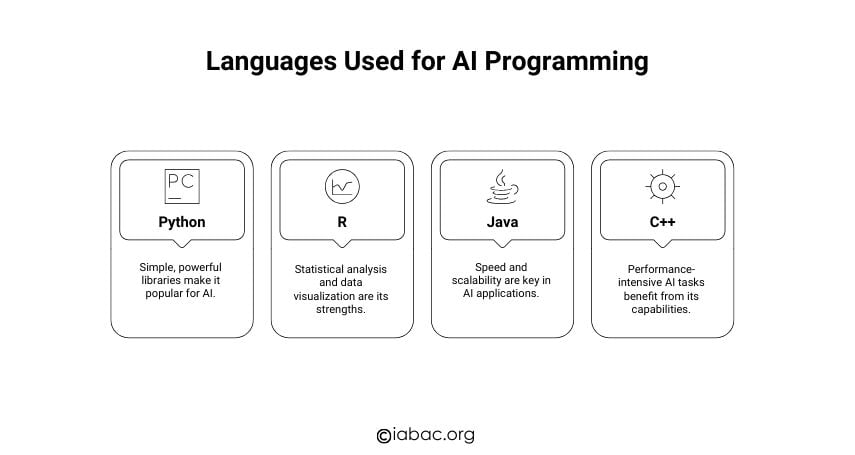
Python: The most popular language for AI because of its simplicity and powerful libraries.
R: Used mainly for statistical analysis and data visualization.
Java: Known for speed and scalability in AI applications.
C++: Used for performance-intensive AI tasks.
Among these, Python is the best choice for beginners because it is easy to learn and has extensive libraries like TensorFlow, PyTorch, and Scikit-learn.
Tools and Libraries for AI Coding
AI development is supported by many tools and libraries. Some essential ones include:
TensorFlow – A popular open-source library for deep learning.
PyTorch – Another deep learning library widely used for research and development.
Scikit-learn – A library for machine learning with simple tools for classification, regression, and clustering.
Keras – A high-level API for building neural networks easily.
Pandas & NumPy – Libraries for data manipulation and numerical computation.
These tools make AI programming easier and faster. You don’t need to build everything from scratch.
Steps to Start Coding AI
Here’s a simple roadmap to start learning AI programming:
Step 1: Learn Python Basics
Before you dive into AI, make sure you are comfortable with Python. Understand variables, loops, functions, and basic data structures.
Step 2: Learn Mathematics
AI relies heavily on mathematics. Focus on:
Linear algebra (matrices and vectors)
Probability and statistics
Calculus (mainly derivatives)
You don’t need to be a math genius, but understanding these concepts will make AI programming easier.
Step 3: Learn Machine Learning
Start with simple machine learning algorithms like linear regression, decision trees, and k-nearest neighbors. These algorithms form the foundation of AI.
Step 4: Work on Projects
The best way to learn is by doing. Start with small projects like:
Predicting house prices
Classifying images of animals
Building a simple chatbot
Step 5: Learn Deep Learning
Once you are comfortable with basic ML, move on to deep learning. Learn about neural networks, convolutional neural networks (CNNs) for images, and recurrent neural networks (RNNs) for text.
Step 6: Explore AI Specializations
AI has many subfields, such as computer vision, NLP, robotics, and reinforcement learning. Choose a specialization based on your interests.
Best Practices for Coding AI
Start Small – Begin with small projects to understand concepts.
Use Libraries – Don’t reinvent the wheel; use AI libraries.
Understand Your Data – Clean and analyze data before training AI models.
Experiment and Iterate – AI requires trial and error. Don’t be afraid to experiment.
Document Your Work – Keep notes on your models, results, and learnings.
Learning Resources
There are plenty of online resources for AI programming:
Online Courses – Platforms like Coursera, Udemy, and edX offer AI programming courses.
Books – Books like “Python Machine Learning” and “Deep Learning with Python” are great for beginners.
Communities – Join forums like Stack Overflow, Reddit AI communities, and GitHub to collaborate and learn.
AI Certification Recommendation
If you want to validate your skills professionally, the IABAC AI Certification is highly recommended. It covers key areas like AI programming, machine learning, and deep learning. This certification is recognized globally and helps you showcase your expertise to employers and clients.
Coding artificial intelligence may seem intimidating at first, but with consistent learning and practice, anyone can master it. Start with Python, understand the math, learn machine learning, and gradually move into deep learning. Build projects, explore AI specializations, and consider professional certifications like IABAC AI Certification to take your skills to the next level.
AI is shaping the future, and by learning to code AI today, you can be a part of this exciting revolution. Start small, stay consistent, and keep experimenting—your journey in AI programming begins now!


